We have been cooperating with our partner universities worldwide for over 40 years. This also includes double degree programs in individual courses.
We are in demand internationally: our students come from 40 nations around the world.
Structure, strategy and goals
The organisational chart
The organisational chart shows the different departments and their assignment to the respective members of the Rectorate. In addition to the visual representation, you will also find a written description below the image.
The responsabilities
The Rector is responsible for departments 1 and 2, as well as the university communications, international office, marketing, strategy and university planning departments, the centre for equal opportunities and diversity, organisational developmentand the centre for women* and equality.
The vice-rector 1 for Teaching and Student Services is responsible for the Quality Management and Student Affairs departments.
The vice-rector 2 for research, transfer and continuing education is responsible for the Research & Transfer and Third Mission departments.
The Chancellor is responsible for the departments of building management, budget and finance, internal auditing, human resources, first-level support, the data center and legal affairs.
Download organisational chart (PDF)
Organigramm_2026_ENG.pdf 13,7 MB , PDF
University Code of Conduct These are our values
Our most important value - Passion
These are the other values and what they mean to us:
We promote individual strengths and develop potential
- Dealing with conflicts, misunderstandings and mistakes in a solution-oriented way allows us to grow
- Through self-reflection and willingness to learn, we enable possibilities and
reach new horizons - We continuously evolve andimprove as individuals
Collectively we achieve more
- It is our belief to treat each other with respect and appreciation, thereby strengthening our community
- We take responsibility for our own and mutual well-being
- We trust each other‘s good intentions
- We care for each other and stand up for each other
- We practice friendly and approachable communication
- We treat each other with consideration and respect
- It is our belief to work together in a solution- and team-oriented manner
We ensure progress
- We train the protagonists of tomorrow’s
society and the professionals of the future - Our sustainable conduct makes an important contribution to society
- We are responsible for the shaping of our common cooperation
- We cultivate a lively and responsible feedback culture
- We organize our work to be resourceconscious and future-oriented
We welcome everyone
- We harness the potential of diversity
- Gender-equity and equal opportunities for all are self-evident for us
- We offer protection against exclusion and discrimination
- We design processes and make decisions as openly and transparently as possible
We and our students are passionate about high-quality and sustainable education
- Teamwork and practice-orientation are the cornerstones of our high-quality standards
- We transform individual contributions into joint successes
- We embrace diverse perspectives in research and teaching
- We conduct our research, teaching and administrative activities with sensitivity towards gender, diversity and inclusion
Download University Code of Conduct
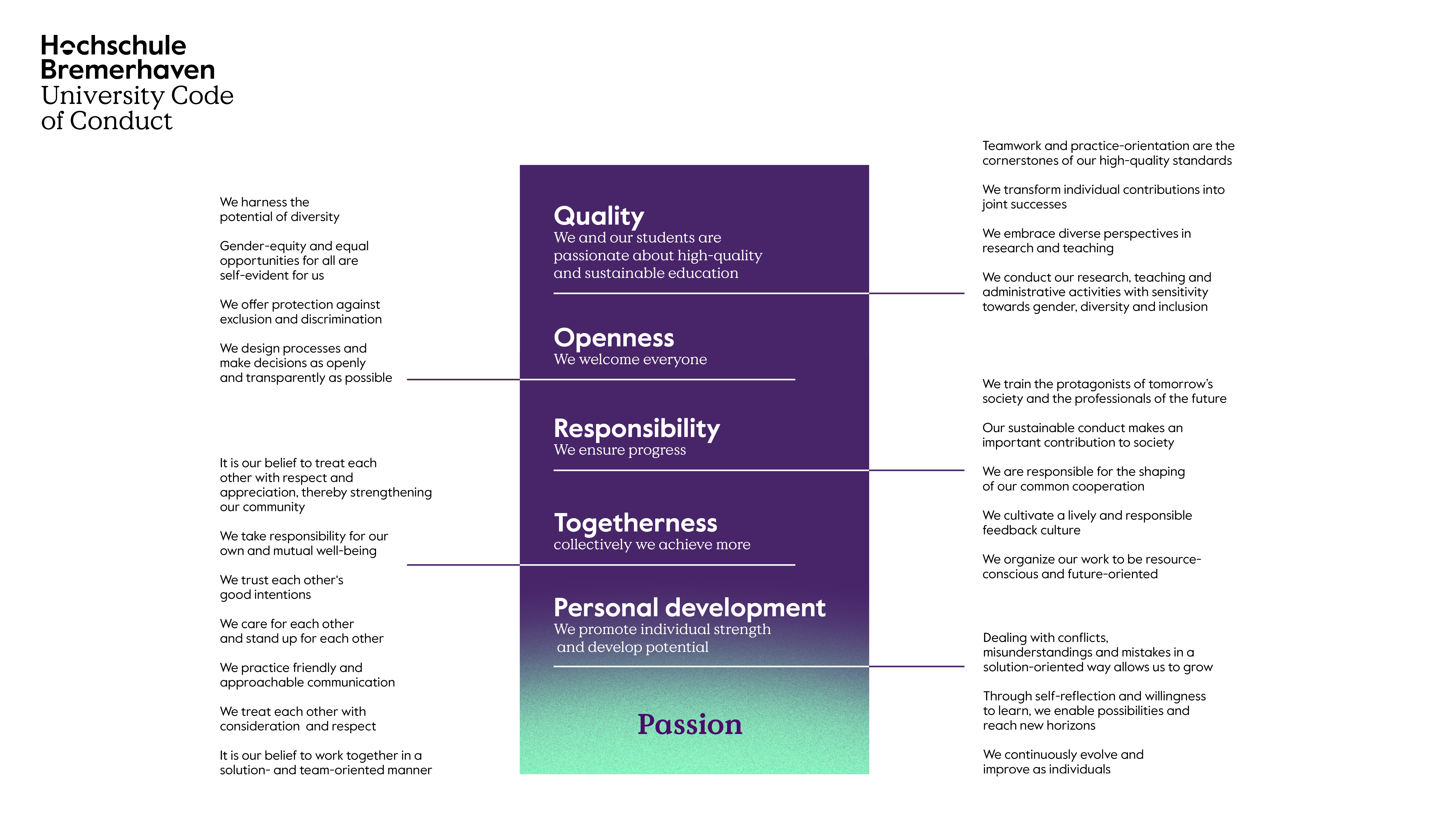
HS-Kodex_16zu9_lila_ENG.jpg 3,5 MB , JPEG
Key areas of the university
Our strategic course
The 3-R strategy of the Rectorate
When it took office in February 2021, the Rectorate adopted a strategy, the implementation of which is being systematically pursued together with the university's employees.
External control
In the federal state of Bremen, there are various instruments for coordinating the course of the state's universities. With regard to Bremerhaven University of Applied Sciences, these include